Recipe
Serves
12 1×
Serves 12 rollsPrep 30 minCook 25 minTotal 2H55 min
Ingredients
Method
- Cook the bacon in a frying pan or under a grill until crisp and cooked through. Drain on kitchen paper, leave to cool completely, then chop into small pieces. Set aside.
- Combine the flour, yeast, sugar and salt in a large bowl. Add the milk, two eggs and softened butter. Mix to form a dough, then knead for 8–10 minutes by hand or 6–8 minutes with a dough hook, until smooth and elastic. Knead in 50 g of the grated Cheddar. Place in a lightly greased bowl, cover and leave in a draught-free place until roughly doubled, about 1 hour.
- Line a baking tin, approximately 23 x 33 cm, with baking paper. Turn the dough onto a lightly floured surface and roll it into a rectangle about 30 x 45 cm. Scatter over the remaining Cheddar and the cooled bacon, leaving a narrow border along one long edge.
- Starting at the opposite long edge, roll the dough into a snug log. Press the clear edge gently to seal. Cut the log into 12 equal pieces and arrange them cut-side up in the tin. Cover and leave to prove for about 1 hour, until visibly puffy.
- Towards the end of the second rise, heat the oven to 180°C conventional or 160°C fan. Brush the rolls with the beaten egg. Bake for about 25 minutes, until golden and set in the centre.
- Leave the rolls in the tin for 10 minutes, then serve warm or transfer to a rack to cool.
Cheddar and Bacon Breakfast Rolls
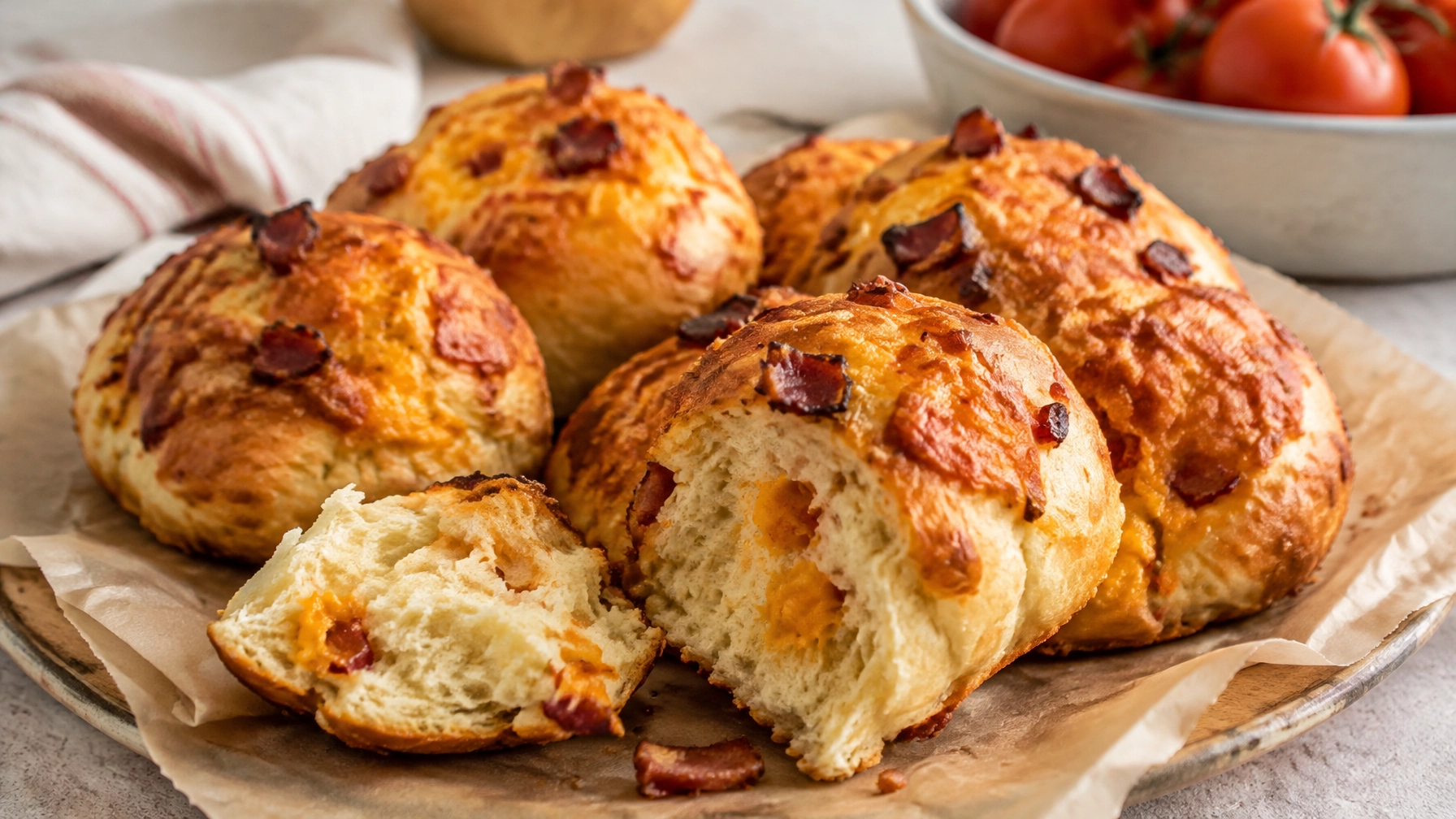
Cheddar and bacon breakfast rolls are enriched yeast rolls with mature cheese and cooked streaky bacon folded through the dough and rolled into a savoury filling. The method makes 12 rolls. Allow time for two rises; the dough’s volume, rather than the clock alone, indicates when it is ready.
Structure
Enriched dough is made with ingredients such as milk, eggs or butter, which add fat and tenderness. Here, milk, eggs and butter give the rolls a soft crumb. The dough is rolled around grated mature Cheddar and crisp bacon, then cut into individual spirals before baking.
Mature Cheddar brings a pronounced flavour that holds its own against the saltiness of bacon. Grating the cheese yourself gives an even texture and helps it distribute through the filling. Cook the bacon until crisp, cool it completely and blot away excess fat before adding it to the dough. Warm bacon can soften the dough and make the filling greasy.
Dough
The mixture should feel soft and slightly tacky after kneading. Avoid adding a large amount of extra flour to make it easier to handle: a dry dough can produce firm rolls. Lightly flour the work surface and use a scraper or lightly oiled hands if it sticks.
Knead until the dough looks smooth and stretches without tearing immediately. This develops the gluten that supports the rolls as they rise. A stand mixer fitted with a dough hook can do the work, but kneading by hand is also suitable. The dough is ready for its first rise when it has expanded noticeably, usually to about double its original size.
Yeast activity varies with room temperature and ingredient temperature. Lukewarm milk is appropriate; very hot milk can impair the yeast. If the kitchen is cool, allow more time for the dough to rise rather than placing it in a hot environment.
Filling
Roll the dough into a broad rectangle of even thickness. A roughly rectangular shape helps produce a log of consistent diameter, which in turn makes it easier to cut 12 rolls of similar size. Scatter the cheese and bacon evenly, leaving a narrow border along one long edge. That clear edge helps seal the log when it is rolled.
Roll from the opposite long edge towards the clear border, keeping the roll snug without squeezing out the filling. Place the cut pieces with their spirals facing upwards in a lined baking tin. A small amount of space between them allows the dough to expand during the second rise. As the rolls bake, they may touch and pull apart easily once cooked.
Proof
Proofing is the resting period during which yeast produces gas and the dough expands. The first rise develops volume; the second rise relaxes the shaped dough and gives the rolls a lighter texture.
For the second proof, look for rolls that are visibly puffy. They need not reach a precise measured size, but they should have expanded and feel airy rather than dense. If they remain small, give them additional time. Begin heating the oven towards the end of this rise so it is ready when the rolls are glazed.
The beaten egg brushed over the surface encourages a golden finish. Bake until the tops are browned and the centres are set. If the tops colour quickly, check that the rolls are baking evenly and reduce the oven temperature slightly if necessary. Allow them to rest briefly before serving; the cheese filling is very hot straight from the oven.
Storage
Serve the rolls warm as a breakfast or brunch item, or cool them before packing for later. The filling is rich and salty, so the rolls can also be served with fruit or a simple salad.
Refrigerate cooled leftovers in a covered container. Follow the Food Standards Agency’s guidance on cooking food and on chilling, freezing and defrosting food safely. Reheat leftovers until steaming hot throughout, and reheat only once. For a softer result, wrap the rolls loosely in foil before reheating in the oven.
Recipe
Servings
12 rolls
Prep time
30 minutes hands-on, plus about 2 hours proving
Cook time
25 minutes
Total time
About 2 hours 55 minutes